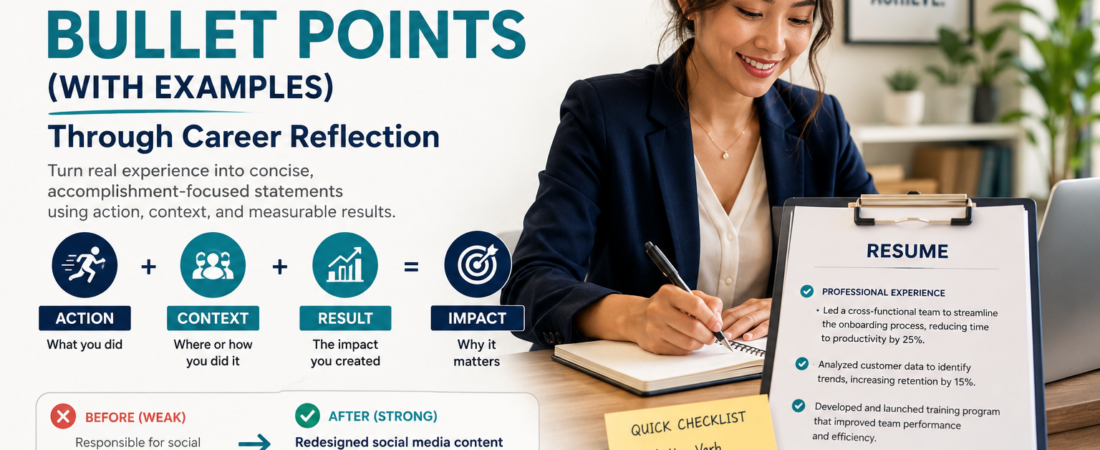
Most resumes are full of duties. The problem? Hiring managers care about impact. Strong resume bullet points are concise accomplishment statements that show what you actually achieved and how you did it.
Reflecting on your real experience is the fastest way to create career-ready language. When you intentionally pause, ask a few focused questions, and translate stories into results, your resume suddenly sounds like the value it represents.
Why strong resume bullet points matter
A great bullet point does three things: it starts with a clear action, describes relevant context, and ends with measurable or tangible results. That combination turns ordinary job descriptions into accomplishment statements that hiring managers and applicant tracking systems notice.
- Action: What you did (use a strong verb).
- Context: Where or how you did it (team, tool, challenge).
- Result: The impact (numbers, time saved, quality improvements, growth).
Start with career reflection: quick prompts to find your accomplishments
Before you write, reflect. Spend 10–20 minutes answering honest, specific prompts about a role or project:
- What was a problem or goal I faced? Why did it matter?
- What actions did I take, and why did I choose them?
- What changed because of my work? Can I quantify it (%, $, time)?
- How did others react (customers, teammates, supervisors)?
- What did I learn or improve that made future work better?
These prompts help you move from duties to accomplishment statements. The clearer your reflection, the stronger your bullet points will be.
A simple formula for each bullet
Use this three-part formula as a template: Action verb + Context + Result.
Examples:
- Before: Responsible for social media posts and content calendar.
- After: Redesigned social media content calendar, increasing engagement by 37% and boosting monthly leads by 18%.
- Before: Helped new clients onboard.
- After: Streamlined client onboarding process, reducing setup time from 10 days to 4 days and improving first-month retention by 12%.
Notice how the revised bullets start with a verb, include context, and finish with a measurable result or clear impact.
Turn reflections into career-ready language
Reflection alone isn’t enough — translate what you learned into language that fits the jobs you want. Tailor each bullet:
- Match keywords from the job posting (but avoid copying whole sentences).
- Prioritize accomplishments that align with the role’s top responsibilities.
- Keep bullets concise: one line when possible, two lines max.
Example transformation from reflection to bullet:
Reflection notes: “Led campus volunteer team to run weekly tutoring sessions. Attendance was low; I reached out to student groups and redesigned flyers. Attendance went from ~8 to 22 students per week. Tutors reported better retention because of a new tracking sheet.”
Resume-ready bullet: “Revamped outreach strategy and promotional materials for campus tutoring program, boosting weekly attendance from 8 to 22 students and improving tutor retention with a streamlined tracking system.”
Quick checklist: polish every bullet
- Start with a strong action verb (e.g., launched, led, automated).
- Avoid weak openings like “Responsible for” or “Assisted with.”
- Quantify results whenever possible (%, $, time, counts).
- Show impact on customers, revenue, efficiency, quality, or growth.
- Keep language active and specific — remove vague modifiers.
- Tailor bullets to each job application; reorder bullets by relevance.
Examples: before and after (three quick swaps)
- Before: Managed inventory for regional stores.
- After: Implemented inventory forecasting that reduced stockouts by 30% across five regional stores.
- Before: Wrote monthly newsletter.
- After: Produced monthly newsletter that increased email click-through rate from 2.1% to 5.6% and generated 120 sign-ups.
- Before: Trained new employees.
- After: Developed onboarding curriculum and trained 24 new hires, cutting ramp-up time by 25%.
Practice makes this easier — and faster
Career reflection is a muscle: the more specific you get about the problems you solved and the impact you made, the faster you’ll produce strong resume bullet points. If reflecting on your experience feels overwhelming, structured tools can guide the process and help you translate stories into accomplishment statements.
Conclusion: Writing strong resume bullet points starts with reflection: pause, ask focused questions about your real work, and translate your answers into action + context + result. With practice, your bullets will show the measurable value you bring — not just the tasks you completed.
Call to action: Ready to turn your experiences into career-ready language? Try the Career Reflection Assistant at UwriteConsulting.com to reflect on your stories and generate targeted, accomplishment-focused resume bullet points