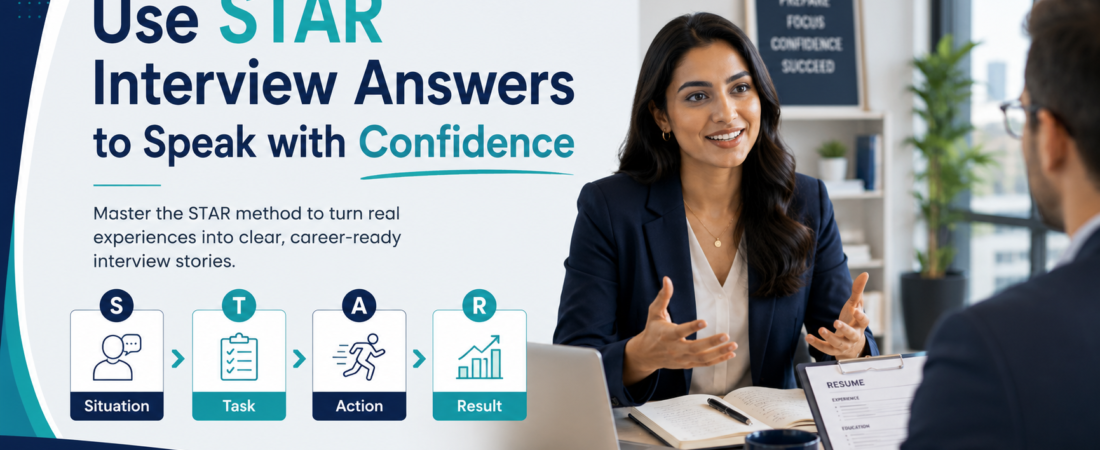
Interviews are less about luck and more about how clearly you tell your story. For early-career professionals, translating class projects, part-time jobs, and volunteer work into persuasive answers can feel awkward. The STAR method gives you a simple structure for answering behavioral questions so your experience reads as intentional, measurable, and relevant.
What is the STAR method?
STAR stands for Situation, Task, Action, Result. It’s a short roadmap you can use on the fly to organize interview stories so they’re easy to follow and focused on outcomes. Using STAR helps you: stay concise, highlight your role, and show impact — all of which build interview confidence.
How to craft strong STAR interview answers
Start by reflecting on real experiences. Early-career roles often offer rich stories — a campus leadership moment, a tight deadline in a group project, or a customer interaction. Turn those moments into career-ready language by following the STAR structure:
- Situation: Briefly set the scene. Where were you and what was the context?
- Task: What needed to happen? What was your responsibility?
- Action: What steps did you take? Focus on what you did, not the team.
- Result: Share measurable outcomes or concrete learning. What changed because of your actions?
Keep answers to about 1–2 minutes. Practice makes them smooth — and practicing with a reflection framework helps you spot the strongest, most relevant stories quickly.
Example STAR interview answer (early-career)
Situation: In my sophomore year I led a study-group of six students preparing for a major coding exam.
Task: Our group was behind and morale was low; I needed to create a plan to get everyone ready in three weeks.
Action: I scheduled focused 90-minute sessions, broke topics into weekly goals, assigned mini-presentations so each person taught a concept, and created a shared resource doc.
Result: Attendance rose from 50% to 95%, average practice test scores improved by 18%, and three members who had been failing passed the exam.
This answer shows leadership, planning, and measurable improvement — all in a compact STAR format.
Tips to make your interview stories stand out
- Be specific: Swap vague words like “helped” for concrete verbs like “organized,” “designed,” or “led.”
- Quantify results when possible: numbers make impact believable.
- Focus on your role: Even if it was a team win, highlight your contribution.
- Share a quick learning: If the result wasn’t perfect, say what you learned and how you improved.
- Keep a bank of 8–12 STAR stories tailored to common competencies (teamwork, problem-solving, leadership, communication, adaptability).
Use career reflection to build confidence
The most confident interview answers come from intentional reflection. Spend time cataloging experiences — even small ones — and identify the skills and outcomes in each. That reflection is what turns lived experience into career-ready language you can use across resumes, LinkedIn, and interviews.
If you struggle to spot the right stories or to phrase them with impact, structured reflection helps you find and sharpen the best examples. Early-career work often feels “incomplete,” but with focused reflection you’ll uncover transferable achievements you hadn’t noticed.
Practice and revise
Record practice answers, read them aloud, and trim anything that doesn’t support the main point. The STAR method keeps you organized; reflection fills your answer bank with substance. As you practice, your confidence will grow — not because you memorized lines, but because you know the true value of your experience.
Conclusion:
STAR interview answers aren’t a script — they’re a clear, repeatable way to translate your real experience into persuasive interview stories. With practice and honest career reflection, you’ll walk into interviews calmer, clearer, and ready to communicate your value.
Call-to-action:
Ready to turn your experiences into polished, career-ready language? Try the Career Reflection Assistant at UwriteConsulting.com to build and refine STAR stories you’ll use confidently in interviews.